



Senior General Manager – National Sales Head

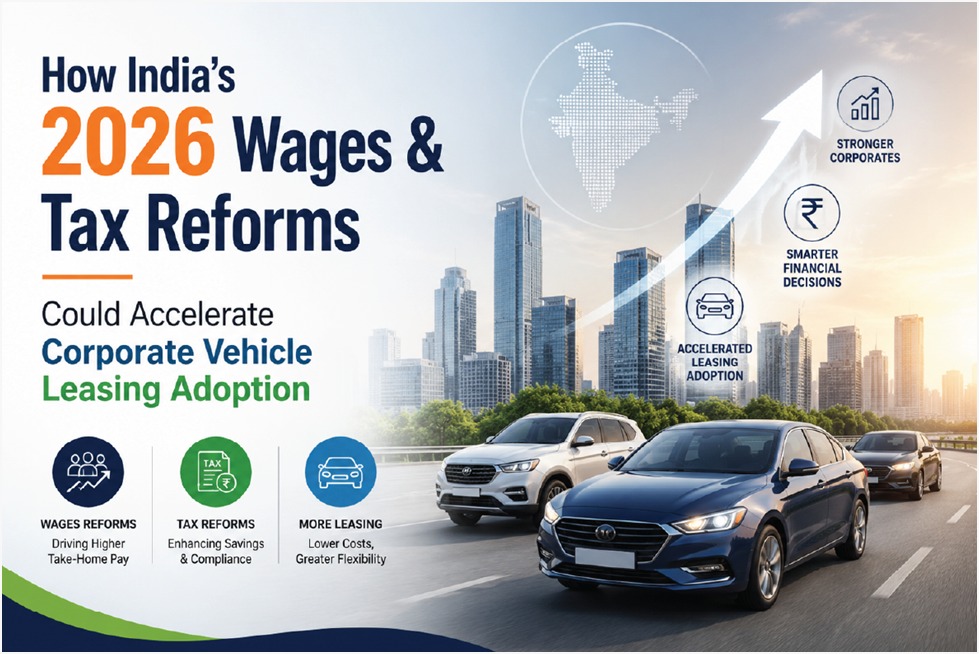
How India’s 2026 Wages & Tax Reforms Could Accelerate Corporate Vehicle Leasing Adoption
India’s 2026 wage and tax reforms are reshaping compensation structures across corporate India.Under the Code on Wages framework, wages, including basic pay and dearness allowance, must make up at least 50% of total remuneration. Earlier, many companies kept basic pay around 30–40% of CTC to reduce PF and gratuity liabilities.
Under the revised wage structure, higher basic pay requirements are increasing statutory contributions, while updated vehicle perquisite taxation is making traditional reimbursement models less efficient. This is accelerating the adoption of Corporate Vehicle Leasing as companies look for smarter, tax-efficient compensation strategies that improve employee value without sharply increasing payroll costs.
Rising EV adoption, increasing vehicle ownership costs, and AI-powered fleet technologies are further accelerating this shift, turning Corporate Vehicle Leasing from an executive perk into a mainstream workforce strategy.
What Changed in India’s 2026 Tax Rules?
The second major reform layer is the Income-tax Rules 2026, effective April 1, 2026, introduced alongside the new Income-tax Act, 2025, which replaced the decades-old Income-tax Act, 1961 with a more streamlined tax framework. The new rules consolidated compliance procedures into 333 structured rules aimed at reducing complexity and improving administration.
The revised framework also increased taxable perquisite values for employer-provided vehicles, pushing more businesses toward Corporate Vehicle Leasing as a cost-efficient and tax-optimized approach to employee mobility benefits.
At the same time, company-leased electric vehicles gained a major advantage through a flat monthly taxable perquisite regardless of vehicle cost, making Corporate Vehicle Leasing more tax-efficient for both employers and employees.
Revised Perquisite Tax Structure
| Benefit Component | Earlier Taxable Value | 2026 Taxable Value |
|---|---|---|
| Electric Vehicle (any cost) | Engine capacity linked | ₹8,000 flat |
| Car Lease (<1.6L engine) | ₹1,800/month | ₹5,000/month |
| Car Lease (>1.6L engine) | ₹2,400/month | ₹7,000/month |
| Chauffeur Benefit | ₹900/month | ₹3,000/month |
Although these revised values increased taxable exposure, they also accelerated the adoption of structured Corporate Vehicle Leasing models instead of traditional reimbursement systems.
Why Corporate Vehicle Leasing Is Growing Rapidly
Indian businesses are increasingly moving toward asset-light and cost-efficient operating models. Instead of investing heavily in company-owned fleets, organizations now prefer flexible leasing structures that reduce financial pressure while improving employee mobility benefits.
Corporate Vehicle Leasing helps companies:
- Reduce upfront capital expenditure
- Avoid long-term vehicle depreciation risks
- Improve cash-flow flexibility
- Simplify vehicle upgrades
- Offer scalable employee mobility programs
This strategy is becoming especially important in industries like IT, consulting, fintech, pharma, and BFSI, where employee retention remains highly competitive.
Why Employees Prefer Leasing-Based Mobility
Rising fuel prices, insurance costs, maintenance expenses, and car loan EMIs are making personal vehicle ownership increasingly expensive in India.
Structured Corporate Vehicle Leasing programs allow employees to access premium vehicles without large upfront investments. In many cases, lease rentals are integrated into salary structuring, improving overall tax efficiency.
Comparing Mobility Models
| Ownership Model | Upfront Cost | Tax Efficiency | Maintenance Burden | Upgrade Flexibility |
|---|---|---|---|---|
| Personal Car Loan | High | Limited | Employee | Low |
| Company Reimbursement | Medium | Moderate | Employee | Medium |
| Corporate Vehicle Leasing | Low | High | Leasing Provider | High |
Industry estimates suggest employees in higher tax brackets could potentially save ₹1.5 lakh to ₹2 lakh annually through optimized lease structures.
EV Leasing Is Becoming a Major Corporate Trend
India’s push toward electric mobility is further accelerating the growth of Corporate Vehicle Leasing.
Companies increasingly prefer leasing EVs instead of purchasing them outright because EV technology continues to evolve rapidly. Leasing reduces depreciation concerns while allowing businesses to upgrade fleets more efficiently.
- High upfront EV costs make Corporate Vehicle Leasing a more cost-efficient alternative
- Rapid technology upgrades allow easier fleet replacement through leasing models
- Battery depreciation uncertainty increases the appeal of lower-risk leasing options
- Evolving charging infrastructure makes leasing more flexible than long-term ownership
- Corporate EV leasing supports ESG and sustainability goals
- It helps reduce overall fleet emissions
- Leasing improves sustainability and compliance reporting
- It also strengthens employer branding and corporate image
As India’s EV infrastructure expands, EV-focused leasing programs are expected to grow significantly over the next few years.
AI and Connected Fleet Technology Are Driving Adoption
Modern Corporate Vehicle Leasing platforms are becoming increasingly technology-driven.
Businesses now use AI-powered fleet systems for:
- Predictive maintenance
- Real-time vehicle tracking
- Automated compliance management
- Fleet utilization analytics
- Driver behavior monitoring
These connected mobility solutions help companies improve operational efficiency while reducing long-term fleet management complexity.
The integration of AI and connected technologies is making leasing models significantly more scalable than traditional company-owned fleet structures.
Conclusion
India’s 2026 wage and tax reforms could become a major turning point for corporate mobility strategies. Higher statutory salary deductions, revised vehicle taxation rules, EV adoption, and AI-driven fleet technologies are accelerating demand for Corporate Vehicle Leasing across India.
What was once viewed as a niche executive perk is now emerging as a mainstream employee mobility and compensation strategy. As businesses prioritize flexibility, cost efficiency, and sustainable mobility, Corporate Vehicle Leasing is expected to play a much larger role in India’s future workforce and compensation planning.
FAQs
Why is Corporate Vehicle Leasing growing in India?
Corporate Vehicle Leasing is growing due to higher salary deductions, revised tax rules, rising vehicle ownership costs, and increasing demand for flexible employee mobility solutions.
How do employees benefit from Corporate Vehicle Leasing?
Employees get lower upfront costs, reduced maintenance stress, easier vehicle upgrades, and potential tax savings through salary-structured lease programs.
Why are companies preferring EV leasing over ownership?
EV leasing reduces depreciation risks, supports easier fleet upgrades, lowers capital expenditure, and helps companies meet sustainability and ESG targets more efficiently.
How are India’s 2026 tax reforms impacting vehicle benefits?
The revised tax framework increased taxable perquisite values for employer-provided vehicles, making structured Corporate Vehicle Leasing more attractive than traditional reimbursement models.